Quick answer: the Amazigh people (plural Imazighen, often called Berbers) are the Indigenous people of North Africa. Moreover, they have lived between the Atlantic, the Mediterranean and the Sahara for thousands of years. Today they live mainly in Morocco, Algeria, Libya, Tunisia, the Siwa oasis in Egypt and the Sahel. In Morocco, for example, about one person in four speaks an Amazigh language at home.
Ask ten travellers who are the Berber people and you will hear ten different answers. For instance, some picture blue-robed nomads on a dune. Others, however, think of a woman weaving a rug in an Atlas village. Both images are real, yet both are tiny pieces of a much larger story. The Amazigh people built kingdoms that traded with Rome, carried Islam into Spain, founded Marrakech and still shape the language, food and music of Morocco today.
That is why this guide answers the questions people actually search for. Where did the Berbers come from? What does the word Amazigh mean? Are Berbers Arab? What religion did they follow before Islam? Which Berber peoples live across North Africa today? We wrote it from Marrakech, where many of our own drivers and guides grew up speaking Tachelhit or Tamazight. If you want the practical side, such as which villages to visit and how to buy a rug, read our companion travel guide to Berber culture in Morocco.
Your 30-second summary
- The Amazigh people are the oldest known population of North Africa, not a group that arrived from elsewhere.
- “Amazigh” is their own name. “Berber” comes from the Greek word barbaros, meaning a foreigner.
- Fossils from Jebel Irhoud in Morocco, about 315,000 years old, are the oldest known Homo sapiens remains.
- Ancient Amazigh kingdoms include Numidia and Mauretania, whose ruins you can still visit at Volubilis.
- Most Amazigh people today are Sunni Muslims, but their history also includes local gods, Judaism and Christianity.
- Morocco’s 2024 census found that 24.8% of the population speaks an Amazigh language.
- Tamazight became an official language of Morocco in 2011. Yennayer, the Amazigh New Year on 14 January, became a paid national holiday from 2024.
- “Amazigh” is not a race. It is a shared identity built on language, history and culture.
Key facts at a glance
| Question | Short answer |
|---|---|
| Who are the Amazigh people? | The Indigenous people of North Africa, from Egypt’s Siwa oasis to the Atlantic and the Canary Islands. |
| Singular and plural | Amazigh (man), Tamazight (woman and language), Imazighen (people), Timazighin (women) |
| Meaning of “Amazigh” | Usually translated as “free person” or “noble person” |
| Main countries | Morocco, Algeria, Libya, Tunisia, Mali, Niger, Mauritania, Egypt (Siwa) |
| Main languages in Morocco | Tachelhit, Central Atlas Tamazight and Tarifit |
| Writing system | Tifinagh, an alphabet with ancient roots |
| Main religion today | Sunni Islam (Maliki school in Morocco) |
| National holiday in Morocco | Yennayer, 14 January (year 2977 begins on 14 January 2027) |
Who are the Amazigh people?
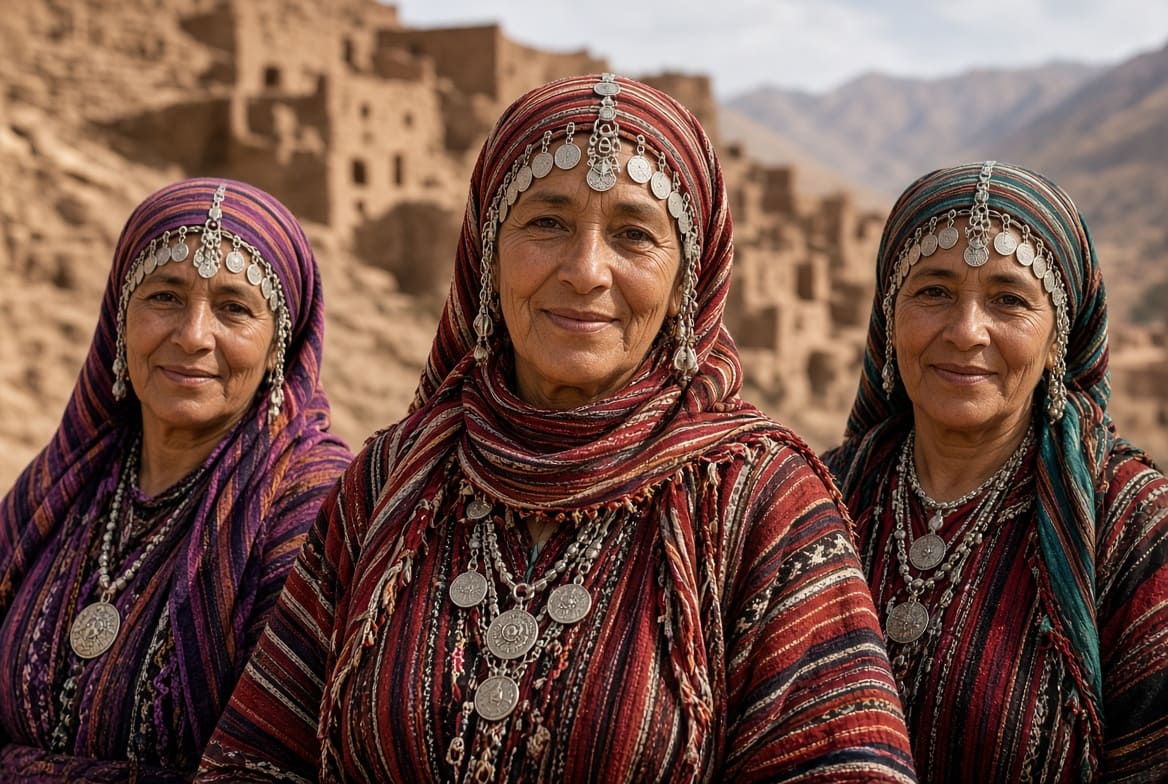
The Amazigh people are the native population of the Maghreb and the northern Sahara. Their homeland, often called Tamazgha, stretches from the Siwa oasis in western Egypt to the Atlantic coast of Morocco. It also reaches south into Mali, Niger and Burkina Faso, where the Tuareg live. Historically, it even included the Canary Islands.
What unites such a huge area? Above all, language. In addition, all Amazigh languages belong to one branch of the Afroasiatic family, the same family that includes Arabic, Hebrew and ancient Egyptian. A Riffian from Al Hoceima and a Chleuh from Agadir speak different varieties, yet linguists group them together. In addition, many traditions repeat across the region: the agricultural calendar, the cooking of couscous, collective dances, silver jewellery and geometric tattoo patterns.
However, the Amazigh people have never formed a single state. Instead, they organised themselves in tribes, confederations and village assemblies. Sometimes those groups united behind a strong leader and built empires. At other times, however, they lived side by side with Phoenicians, Romans, Arabs, Andalusians and Europeans. As a result, Amazigh identity has always been flexible, local and deeply rooted in place.
So when someone asks “who are the Berber people,” the most accurate answer is this. In other words, they are not a tribe or a lifestyle. They are the descendants of North Africa’s oldest inhabitants, plus everyone who joined them and adopted their language over the centuries.
What does Amazigh mean? Is the name original?
The word Amazigh is usually translated as “free person” or “noble person.” The plural is Imazighen. Linguists still debate the exact root, but the free-person meaning is the one Amazigh people themselves most often give.
Is the name Amazigh original, or a modern invention? It is genuinely old. In fact, Greek and Roman writers recorded tribes in North Africa with very similar names. The Greek historian Herodotus wrote about the Maxyes in the fifth century BC. Later, Roman sources mention the Mazices, a people living in what is now Algeria and Morocco. As a result, many scholars link both names to the word Amazigh. In other words, North Africans were calling themselves something close to Amazigh more than two thousand years ago.
The name has also survived inside the language. Women are called Tamazight, and Tamazight is also the name of the language in many regions. Some groups use local forms. For example, the Tuareg say Imuhagh, Imushagh or Imajeghen, depending on dialect. The change of sounds is regular, so these are cousins of the same word.
Spelling varies too. You will see amazigh, amazegh, amezigh and amazight online. They are simply different transcriptions. However, the standard English spelling is Amazigh, with Imazighen as the plural.
Amazigh or Berber: which word should you use?
The English word “Berber” has a long and uncomfortable history. Indeed, it goes back to the Greek barbaros, used for anyone who did not speak Greek. The Romans turned it into barbarus. Later, Arabic writers used barbar for the native peoples of the Maghreb. Finally, European colonial scholars spread “Berber” around the world.
So, are Berbers Amazigh? Yes. They are the same people. “Berber” is the outside label, while “Amazigh” is the name the people use for themselves. Many Moroccans still say “Berber” casually, and some even use it with pride. Nevertheless, in writing and in polite conversation, Amazigh is the safer and more respectful choice.
In this guide we use both words, because many readers search for “Berber.” Still, when you speak with a guide in the Atlas, try saying Amazigh. You will often see a smile.
Where did the Amazigh people come from?
This is one of the most searched questions about the Amazigh people, and the honest answer is simple. As far as science can tell, they did not come from anywhere. Instead, they are the result of very long local history, mixed with several waves of newcomers.
The oldest Homo sapiens in the world
In 2017, a team published new dates for human fossils found at Jebel Irhoud, between Marrakech and Safi. Remarkably, the bones are about 315,000 years old, so they are older than any other known Homo sapiens. In other words, that makes them the oldest known remains of our own species anywhere on Earth. They do not prove that modern Amazigh people descend directly from those first humans. However, they show that North Africa was part of the human story from the very beginning.
The Taforalt genomes
Much closer to us, the Grotte des Pigeons at Taforalt, near Berkane in eastern Morocco, has given scientists precious ancient DNA. Genomes published in 2018 come from people who lived there around 15,000 years ago. In short, they carried roughly two-thirds Near Eastern ancestry and one-third sub-Saharan African ancestry. In short, North Africans were already a mix of African and Eurasian roots long before farming arrived.
Farmers, herders and the Afroasiatic languages
Later, farmers from Iberia and the Near East reached North Africa, and pastoral groups moved across a greener Sahara. Over thousands of years, then, these populations blended. At some point, the ancestor of the Amazigh languages spread across the region. Linguists still debate exactly when. Even so, they agree that the languages are native to Africa and very old.
Modern genetic studies support this picture. Most North Africans carry a distinctive local ancestry component, found at its highest levels among Amazigh-speaking groups. On top of it, moreover, sit layers from the Middle East, Europe and sub-Saharan Africa. Therefore, the best short answer to “where did the Berbers come from” is: from North Africa itself.
For more on this deep past, including the African Union and Gnawa music, see our guide to Morocco’s African identity.
Ancient Berber kingdoms: Numidia and Mauretania
However, ancient Berber history did not wait for Rome or Islam. By the first millennium BC, the Amazigh people traded with the Phoenician cities on the coast, including Carthage, Lixus and Mogador. Then, after the Punic Wars, powerful Amazigh kingdoms emerged.
Numidia and Massinissa
Numidia covered much of present-day Algeria and part of Tunisia. Its most famous king, Massinissa, ruled from about 202 to 148 BC. First, he allied with Rome against Carthage and turned Numidia into a rich agricultural state. Later, his grandson Jugurtha fought a long war against Rome, which the historian Sallust described in detail.
Mauretania and Volubilis
Further west, the kingdom of Mauretania covered northern Morocco. Its best-known ruler, Juba II, was a scholar king who married Cleopatra Selene, daughter of Cleopatra and Mark Antony. In particular, one of his capitals was Volubilis, near Meknes. Today Volubilis is a UNESCO World Heritage Site, and its mosaics are among the finest in North Africa. So, if you travel between Fes and Chefchaouen, it makes an easy stop. Our guide to Fes, Morocco explains how to fit it in.
Amazigh figures of the Roman world
Under Rome, North Africa produced some of the empire’s best-known figures. Saint Augustine of Hippo, one of the most influential thinkers in Christian history, was born in Thagaste, in present-day Algeria, to a family of Amazigh background. Similarly, the writer Apuleius came from Madauros in Numidia. In short, ancient Berber culture was never isolated. It was part of the Mediterranean world.
The Amazigh people and the arrival of Islam
Arab armies reached North Africa in the seventh century. The conquest was long and difficult, because Amazigh tribes resisted fiercely. Two leaders stand out. Kusaila, a chief of the Awraba tribe, defeated the Arab general Uqba ibn Nafi around 683. A few years later, a woman known as Dihya, or al-Kahina, led resistance in the Aurès mountains of Algeria. Even today, she is a symbol of Amazigh courage.
Eventually, however, most Amazigh people embraced Islam. They then carried it far beyond the Maghreb. Later, in 711, Tariq ibn Ziyad, an Amazigh commander, crossed the strait into Spain. The rock where he landed still bears his name: Jabal Tariq, or Gibraltar. Most soldiers in that first army were Amazigh, not Arab.
Amazigh dynasties that built Morocco
Over the next centuries, several of Morocco’s greatest dynasties came from Amazigh confederations.
- The Barghawata ruled the Atlantic plains from the eighth to the eleventh century. They even developed their own religious book in an Amazigh language.
- The Almoravids came from the Sanhaja nomads of the western Sahara. Around 1070, their leaders founded Marrakech. Under Yusuf ibn Tashfin they ruled from Senegal to central Spain.
- The Almohads began in the High Atlas village of Tinmel with the preacher Ibn Tumart. They built the Koutoubia in Marrakech, the Hassan Tower in Rabat and the Giralda in Seville.
- The Marinids were Zenata Amazigh from the eastern steppes. They made Fes a centre of learning and built many of its beautiful madrasas.
This history matters for visitors. When you walk past the gates of the medina of Marrakech, you are looking at an Amazigh imperial capital. Moreover, the Almohad mosque of Tinmel, rebuilt after the 2023 earthquake, sits on the road over the Tizi n’Test pass.
Religion of the Amazigh people: before and after Islam
Amazigh religion is one of the most fascinating parts of this history. Before Islam, North Africans honoured many sacred forces. For example, ancient writers describe the worship of the sun and the moon. Furthermore, a ram-headed god linked to Amun had a famous oracle at the Siwa oasis, which Alexander the Great visited in 331 BC. In Libya, the god Gurzil was carried into battle in the form of a bull. Many communities also respected ancestors, sacred springs, caves and trees.
Even so, some of those beliefs survived in new forms. For instance, the veneration of local saints and their shrines, called marabouts, remains strong in rural Morocco. Likewise, seasonal rituals linked to rain and harvest still mark the farming year in some valleys.
Judaism and Christianity
In fact, Judaism took root in North Africa very early. Some Amazigh tribes may have adopted it, and Jewish communities lived for centuries in Atlas villages and desert oases. Until the mid-twentieth century, there were Jewish families who spoke Amazigh languages in places such as the Draa and the Todra valleys. Christianity also spread widely under Rome. Later, North Africa produced bishops, martyrs and the powerful Donatist church.
Amazigh people and Islam today
Today, the great majority of Amazigh people in Morocco are Sunni Muslims who follow the Maliki school, like other Moroccans. In Algeria, the Mozabites of the M’zab valley follow the Ibadi branch, and so do communities on Djerba in Tunisia and in Libya’s Nafusa mountains. Our guide to religion in Morocco explains how faith shapes daily life, from Ramadan to the call to prayer.
So, what is the religion of the Amazigh? Mostly Islam, with deep layers of older belief and a long Jewish and Christian past. In practice, it is a religion lived through village mosques, family celebrations and local saints.
Arab and Amazigh: one people or two?
“Are Berbers Arab?” is a question many visitors ask quietly. The short answer is no. Amazigh and Arab are different identities with different languages and histories. Yet the full answer is more interesting.
By contrast, Arabic arrived in North Africa with the conquest in the seventh century. It spread much more widely after the eleventh century, when the Banu Hilal and Banu Sulaym tribes moved west from Egypt. Over time, many Amazigh communities, especially in the plains and cities, shifted to Arabic. Meanwhile, Arab families married into Amazigh families for more than a thousand years.
As a result, the line between “Arab” and “Amazigh” in Morocco is more about language and personal identity than about ancestry. Genetic studies suggest that most Moroccans, including many who speak only Darija, have mainly local North African roots. In other words, many “Arab” Moroccans are Arabised Amazigh people. That is why you will hear terms such as Arab-Berber or Arab-Amazigh.
Who are the Maghrebi people?
“Maghrebi people” is a wider, regional term. In other words, it covers everyone from the Maghreb, meaning Morocco, Algeria, Tunisia, Libya and Mauritania, whatever their language. A Maghrebi person can be Amazigh, Arab, both, or neither. For example, a Moroccan Jew from Essaouira or a Sahrawi from Laayoune is Maghrebi too.
Moreover, the Moroccan constitution of 2011 reflects this mix. It describes national identity as built on Arab-Islamic, Amazigh and Saharan-Hassani components, enriched by African, Andalusian, Hebrew and Mediterranean influences. In everyday life, many Moroccans simply say they are Moroccan first.
Is there an “Amazigh race”?
People sometimes search for “amazigh race” or ask whether Berbers are black or white. Here, science is clear. There is no Amazigh race. Amazigh is an ethnolinguistic identity, defined by language, history and culture, not by skin colour.
In fact, the Amazigh people look very different from region to region. Up north in the Rif, you will meet people with fair skin and light eyes. In the Draa valley and the deep south, many families have darker skin and close ties with sub-Saharan Africa. The Tuareg of the Sahel are different again. All of them are Amazigh, because they share the languages and the traditions.
So, if you hear a guide say “my grandmother was Amazigh and my grandfather was Arab,” that is completely normal. In the end, identity in North Africa has always been about belonging, not about appearance.
The Berber peoples of North Africa today
Berber people of North Africa are not one group, but many. Still, each region has its own name, language variety and customs. The table below covers the main ones, including the Libyan Amazigh and the Tuareg of the Sahel.
| Group | Main area | Language | Good to know |
|---|---|---|---|
| Ishelhin (Chleuh) | Morocco: Souss, High Atlas, Anti-Atlas | Tachelhit | Largest Amazigh group in Morocco; famous for argan, trade and Ahwach dance |
| Imazighen of the Middle Atlas | Morocco: Middle Atlas, eastern High Atlas, southeast | Central Atlas Tamazight | Includes the Ait Atta, Ait Hdiddou and Zayane; known for wool rugs and the Imilchil moussem |
| Riffians (Irifiyen) | Morocco: the Rif, Nador, Al Hoceima | Tarifit | Led the Rif Republic (1921 to 1926) under Abd el-Krim |
| Kabyles | Algeria: Kabylie | Taqbaylit | Largest Amazigh group in Algeria; strong literary and music tradition |
| Chaouis | Algeria: Aurès mountains | Tachawit | Homeland of the resistance leader Dihya (al-Kahina) |
| Mozabites | Algeria: M’zab valley | Tumzabt | Ibadi Muslims; their towns are a UNESCO site |
| Libyan Amazigh | Libya: Nafusa mountains, Zuwara, Ghadames | Nafusi, Zuwara dialects | Amazigh identity grew much more visible after 2011 |
| Djerbians and southern Tunisians | Tunisia: Djerba, Matmata, Tataouine | Local varieties | Small speaker numbers; troglodyte homes in Matmata |
| Siwis | Egypt: Siwa oasis | Siwi | The easternmost Amazigh language |
| Tuareg (Imuhagh) | Mali, Niger, southern Algeria, Libya, Burkina Faso | Tamasheq, Tamajaq | Nomadic tradition; men traditionally wear the indigo veil |
| Guanches (historical) | Canary Islands, Spain | Extinct | Ancient DNA shows North African Amazigh origins |
Exact numbers are hard to give, because many countries do not count ethnicity. Estimates for the whole region range from about 25 to 40 million speakers, and many more people with Amazigh roots who no longer speak the language.
Amazigh people in Morocco: numbers and regions
Morocco has the largest Amazigh-speaking population in the world. According to the general census of September 2024, the country had 36,828,330 inhabitants. Of these, as a result of the survey, 24.8% said they use an Amazigh language. That share breaks down into Tachelhit (14.2%), Central Atlas Tamazight (7.4%) and Tarifit (3.2%). Amazigh activists argue the real figure is higher, because many bilingual families answered “Darija.” Either way, the number represents roughly nine million people.
Geographically, the Amazigh people of Morocco form three large blocks. The Souss and the western High Atlas speak Tachelhit. Meanwhile, the Middle Atlas, the eastern High Atlas and the oases of the southeast speak Tamazight. Finally, the Rif in the north speaks Tarifit. In addition, cities such as Casablanca, Marrakech, Agadir and Rabat host large Amazigh communities who moved there for work.
In short, Amazigh Moroccans are not only villagers. They include doctors in Casablanca, shop owners in Paris, footballers on the national team and engineers in Tangier. For the wider demographic picture, see our guide to Morocco’s population.
Language of the Amazigh people and Tifinagh
Amazigh languages are spoken, sung and written. The traditional alphabet, Tifinagh, descends from the ancient Libyco-Berber script found on rock inscriptions across the Sahara. The Tuareg never stopped using it. Then, in 2003, Morocco adopted a standardised version called Neo-Tifinagh, developed by the Royal Institute of Amazigh Culture (IRCAM).
Today you can see Tifinagh on road signs, ministries, schools and railway stations, usually next to Arabic and French. The letter you will notice most is ⵣ, called yaz. It represents the sound “z” in the word Amazigh, and it has become a symbol of the whole people.
A few words travellers enjoy learning:
- Azul: hello (literally, peace)
- Tanmirt: thank you (Tachelhit and Tamazight)
- Mamek tellid?: how are you? (Tamazight)
- Aman: water
- Tigemmi: house
For a full picture of Darija, Amazigh, French and Spanish in daily life, read what language is spoken in Morocco.
Symbols of the Amazigh people
The Amazigh flag
The Amazigh flag has three horizontal bands: blue for the sea, green for the land and yellow for the desert. In the centre stands a red yaz (ⵣ), the symbol of the free human and of resistance. The World Amazigh Congress adopted it in 1997 at a meeting in Tafira, on Gran Canaria. However, it is a cultural flag, not the flag of any state, and you will see it at concerts, festivals and football matches.
Jewellery, tattoos and patterns
Geometric signs repeat across Amazigh art: diamonds, zigzags, crosses and triangles. For example, women traditionally wore them as facial tattoos, and weavers repeat them in rugs. Likewise, silver fibulas, called tizerzai, and heavy amber necklaces are signs of status and protection. Our guide to traditional Moroccan clothing shows how these designs appear in dress.
Food as identity for Amazigh people
Couscous, known in Amazigh as seksu, is the most famous Amazigh dish. In 2020, UNESCO inscribed the knowledge and practices around couscous on its intangible heritage list, after a joint nomination by Morocco, Algeria, Mauritania and Tunisia. Other Amazigh staples include tagella bread, barley soup, amlou and the Friday couscous with seven vegetables. Explore more in our guide to traditional Moroccan dishes.
Amazigh history in Morocco: a modern timeline
The modern history of the Amazigh people in Morocco moves from colonial division to official recognition. Here are the key dates.
| Year | Event |
|---|---|
| 1921 to 1926 | The Rif War. Abd el-Krim defeats the Spanish army at Annual (July 1921) and proclaims the Rif Republic. |
| 1930 | The French “Berber Dahir” tries to place Amazigh areas under separate customary courts. The protest that follows helps launch the nationalist movement. |
| 1956 | Independence. Arabic becomes the only official language. |
| 2001 | King Mohammed VI’s speech at Ajdir (17 October) announces the creation of IRCAM. |
| 2003 | Neo-Tifinagh is adopted and Amazigh teaching begins in primary schools. |
| 2011 | The new constitution (Article 5) makes Amazigh an official language alongside Arabic. |
| 2019 | Organic Law 26-16 sets out how Amazigh will be used in schools, courts, media and public services. |
| 2023 | A royal decision of 3 May makes Yennayer a paid national holiday, first observed on 14 January 2024. |
| 2023 to 2030 | The education ministry plans to extend Amazigh teaching to every primary school by the 2029-2030 school year, with a target of 4 million pupils. |
Progress is real, although activists point to slow implementation. For example, the shortage of trained teachers remains the biggest obstacle in schools. Still, compared with 2000, Amazigh visibility in public life has changed dramatically.
Music and dance of the Amazigh people
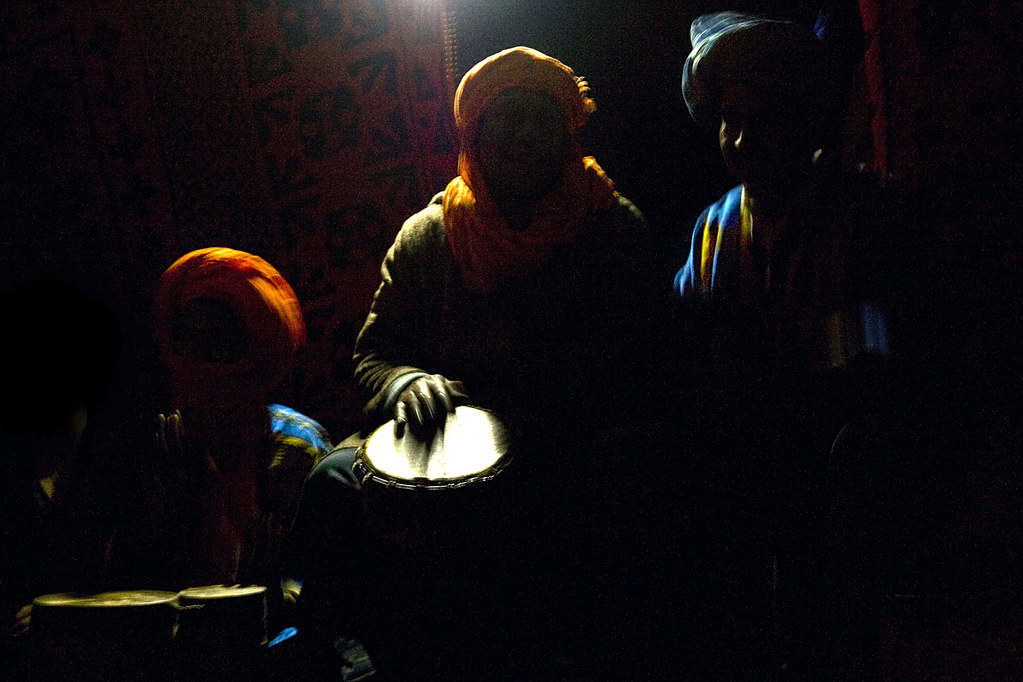
Music is where many visitors first feel Amazigh culture. In the Souss and the High Atlas, ahwach brings whole villages together in long lines of singers and dancers around a fire. In the Middle Atlas, meanwhile, ahidous mixes poetry, clapping and frame drums. Meanwhile, the rrways, travelling poet-musicians of the Souss, play the one-stringed ribab and sing about love, exile and politics.
Modern artists carry the tradition forward. Groups such as Izenzaren and Oudaden filled concert halls in the 1970s and 1980s, and today young singers mix Amazigh lyrics with rock, reggae and electronic beats. In addition, the Taskiwin martial dance of the western High Atlas appears on UNESCO’s list of heritage in need of urgent safeguarding. If you hear drums in a village during your trip, ask your guide whether it is a wedding. As a guest, you may be invited to watch, and sometimes even to join in.
Yennayer: the New Year of the Amazigh people
Yennayer marks the first day of the Amazigh agricultural year. In Morocco it falls on 14 January, while Algeria celebrates on 12 January. The calendar counts years from 950 BC, a date linked to the Libyan pharaoh Sheshonq I. That is why 14 January 2026 opened the year 2976, and 14 January 2027 will open 2977.
Families celebrate with a big meal. In many homes, cooks hide a date pit or an almond in the couscous or the tagulla porridge, and whoever finds it will have good luck all year. Today, moreover, cities host concerts, markets and exhibitions. If you plan a winter trip, our guide to New Year in Morocco explains how Yennayer fits alongside 31 December and the Islamic new year.
Where travellers can meet the Amazigh people
In fact, you do not need to search for “authentic” villages. Amazigh life is everywhere outside the big cities, and it is very present inside them too. Here are the easiest places to start.
- High Atlas valleys: an Imlil Valley day trip from Marrakech or the Ourika Valley brings you to Tachelhit-speaking villages within 90 minutes.
- Ait Ben Haddou and the Ounila valley: earthen ksour built by Amazigh families. Visit on an Ait Ben Haddou day trip.
- Dades, Todra and the road of a thousand kasbahs: home of the Ait Atta confederation. A 5-day tour from Marrakech to the Sahara covers it at a gentle pace.
- Merzouga and Erg Chebbi: Amazigh, Arab and Gnawa families share the desert edge. Read our Sahara Desert Morocco guide.
- Middle Atlas: cedar forests, Azrou and the Ait Hdiddou country, crossed on the 3-day tour from Fes to Merzouga.
For full practical advice on etiquette, photos and buying rugs, see our Berber Morocco travel guide and the wider Atlas Mountains guide.
Five common myths about the Amazigh people
Myth 1: “Berbers are nomads”
Most Amazigh people have always been farmers living in permanent villages. Nomadism exists, especially among the Tuareg and some groups of the southeast, but it is the exception.
Myth 2: “Berbers live only in the mountains”
Mountains protected the language, yet Amazigh history is also urban. Marrakech was an Amazigh capital, and millions of Amazigh Moroccans live in cities today.
Myth 3: “Amazigh is a dialect of Arabic”
No. Amazigh languages form their own branch of the Afroasiatic family. In fact, they are as different from Arabic as English is from Russian.
Myth 4: “The Berbers came from Europe” or “from Yemen”
Both theories circulated in the past. Neither is supported by modern genetics or archaeology, which point to long local continuity in North Africa.
Myth 5: “Amazigh culture is disappearing”
Some varieties are under pressure, but the overall trend in Morocco is revival. Amazigh music fills stadiums, Tifinagh is taught in schools, and young people proudly post in Tamazight online.
Key takeaways about the Amazigh people
- The Amazigh people are the Indigenous inhabitants of North Africa, from Siwa to the Atlantic.
- Amazigh means “free person”; the word Berber is an outside label from Greek.
- Their history includes Numidia, Mauretania, the conquest of Spain in 711 and the Almoravid, Almohad and Marinid empires.
- Most are Sunni Muslims today, with older layers of belief and a Jewish and Christian past.
- Amazigh is an identity, not a race; Arab and Amazigh ancestry in Morocco is deeply mixed.
- About a quarter of Moroccans speak Tachelhit, Tamazight or Tarifit, according to the 2024 census.
- Tamazight has been official since 2011, and Yennayer has been a national holiday since 2024.
Frequently asked questions about the Amazigh people
Who are the Berber people?
The Berber people, or Amazigh, are the Indigenous population of North Africa. They live mainly in Morocco, Algeria, Libya, Tunisia, Egypt’s Siwa oasis and the Sahel, and they share related languages and traditions.
What does Amazigh mean?
Amazigh is usually translated as “free person” or “noble person.” The plural is Imazighen, and Tamazight refers to a woman and to the language.
Is the name Amazigh original?
Yes. Greek and Roman writers recorded North African peoples called the Maxyes and the Mazices more than two thousand years ago, and many scholars link those names to Amazigh.
Are Berbers and Amazigh the same?
Yes. Berber is the outside name, from the Greek barbaros. Amazigh is the name the people use for themselves, and it is generally the more respectful choice.
Where did the Berbers come from?
They come from North Africa itself. Archaeology and ancient DNA, including the 15,000-year-old Taforalt genomes, show long local continuity mixed with later arrivals.
What was the religion of the Amazigh before Islam?
The Amazigh honoured the sun, the moon, local spirits and gods such as the Amun of Siwa and Gurzil. Many communities later adopted Judaism or Christianity before Islam arrived in the seventh century.
Are Berbers Arab?
No. Amazigh and Arab are different identities with different languages. However, centuries of mixing mean that many Arabic-speaking Moroccans have Amazigh ancestry.
Is there an Amazigh race?
No. Amazigh is an ethnolinguistic identity based on language and culture. Amazigh people range from fair-skinned Riffians to dark-skinned families of the Draa valley.
How many Amazigh people live in Morocco?
The 2024 census found that 24.8% of Moroccans speak an Amazigh language, which is roughly nine million people. Many more have Amazigh roots but speak Darija.
What languages do Amazigh people speak in Morocco?
The three main varieties are Tachelhit in the south and Souss, Central Atlas Tamazight in the Middle Atlas and southeast, and Tarifit in the Rif.
Who are the Libyan Amazigh?
The Libyan Amazigh live mainly in the Nafusa mountains, the coastal town of Zuwara and the oasis of Ghadames. Their culture became much more visible after 2011.
When is the Amazigh New Year?
In Morocco, Yennayer falls on 14 January and has been a paid national holiday since 2024. The year 2977 begins on 14 January 2027.
Travel with people who grew up Amazigh
Reading about the Amazigh people is a good start. Meeting them is better. On our private routes, for example, many of our drivers and guides speak Tachelhit or Tamazight at home. They can explain an irrigation channel, translate a conversation with a grandmother in Imlil or show you where their family’s village sits on the road to the desert.
Browse our tours from Marrakech, compare the 7-day private tour to the Sahara or read who we are. When you are ready, contact us and tell us that Amazigh culture matters to you. Azul, and see you in Morocco.
Sources: Morocco’s 2011 Constitution; Haut-Commissariat au Plan, RGPH 2024; Hublin et al., Nature (2017); van de Loosdrecht et al., Science (2018); UNESCO, couscous (2020); UNESCO, Archaeological Site of Volubilis; HCP; Moroccan Ministry of National Education circular of May 2023.